
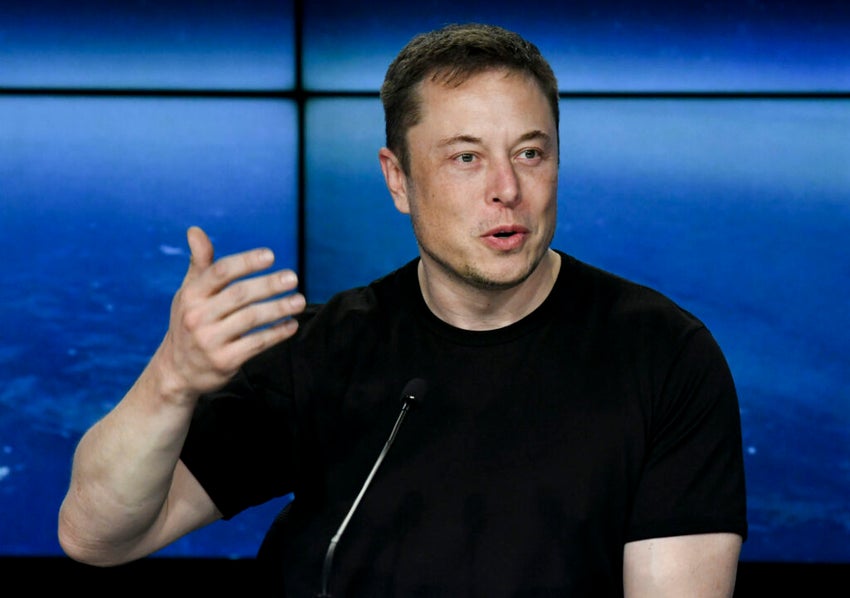
Clocking out after 40 hours might feel like balance to most people, but to Elon Musk, it's the reason your name isn't in a history book. Musk, who runs Tesla, SpaceX, X, and Neuralink, says world-changing work doesn't happen on a standard schedule.
In a 2018 post on X, Musk replied to a Wall Street Journal article calling Tesla one of the most in-demand employers in Silicon Valley. He responded bluntly: "There are way easier places to work, but nobody ever changed the world on 40 hours a week."
That line kicked off a flurry of questions. One user asked, "What's the correct number of hours a week to change the world?"
Don't Miss:
- Missed Nvidia and Tesla? RAD Intel Could Be the Next AI Powerhouse — Just $0.85 a Share
- Deloitte's #1 Fastest-Growing Software Company Lets Users Earn Money Just by Scrolling — Accredited Investors Can Still Get In at $0.50/Share.
Musk answered, "Varies per person, but about 80 sustained, peaking above 100 at times. Pain level increases exponentially above 80."
He added, "If you love what you do, it (mostly) doesn't feel like work."
That wasn't just rhetoric. In 2021, Musk shared on X that Tesla's critical financing round—needed to make payroll—closed at 6 p.m. on Christmas Eve. "That was a crazy tough year," he wrote. Had the deal fallen through, employee paychecks would've bounced two days after Christmas. While most companies were shutting down for the holidays, Musk was scrambling to keep the engine running.
Two years later, the grind didn't let up. After acquiring Twitter and rebranding it to X, Musk was facing a ballooning $100 million data center bill. According to "Elon Musk," the 2023 biography by Walter Isaacson, Musk ordered a massive server migration from Sacramento, California to Portland, Oregon and rejected the nine-month timeline proposed by his team. He gave them 90 days. Anyone who couldn't deliver, he told them, could submit their resignation.
Trending: An EA Co-Founder Shapes This VC Backed Marketplace—Now You Can Invest in Gaming's Next Big Platform
When delays mounted, Musk boarded a plane and diverted mid-flight to Sacramento. On Christmas Eve, he joined a small team—made up of engineers and cousins from Tesla and SpaceX—and personally helped tear up floor tiles with a pocket knife, crawl under server racks, and rewire electrical panels. Isaacson described the scene as peak recklessness. Musk treated it like just another day getting things done.
Even his private moments followed that same pattern. As recounted in Isaacson's biography, Musk once went barefoot into a snowstorm on Christmas Eve to find flowers for then-wife Talulah Riley. He came back hours later, bleeding and frozen—but holding the bouquet. Romance, Musk-style.
Musk isn't just pushing employees—he lives by the same intensity. He's not interested in balance or rest.
And while that may be what he believes it takes to change the world, most Americans aren't chasing breakthroughs. They're trying to survive. According to the Bureau of Labor Statistics data for September, roughly 8.8 million U.S. workers hold two or more jobs—a clear sign that for many, grinding beyond 40 hours isn't about disruption or legacy. It's about keeping the lights on.
Read Next:
- GM-Backed EnergyX Is Solving the Lithium Supply Crisis — Invest Before They Scale Global Production
- From Moxy Hotels to $12B in Real Estate — The Firm Behind NYC's Trendiest Properties Is Letting Individual Investors In.
Image: USA Today Network
© 2025 Benzinga.com. Benzinga does not provide investment advice. All rights reserved.


