Ethereum is now six years old. But in that short time frame since its launch on July 30, 2015, a lot has happened. Ethereum has established itself as the most actively used blockchain network, while its native token, ether, is now the second-largest cryptocurrency by both market capitalization and daily volume.
To mark its sixth birthday, we examine six reasons why ethereum has intrinsic value.
1) Smart Contract Capability
Ethereum was built as a platform to run programmatic smart contracts and applications via its own currency – ether.
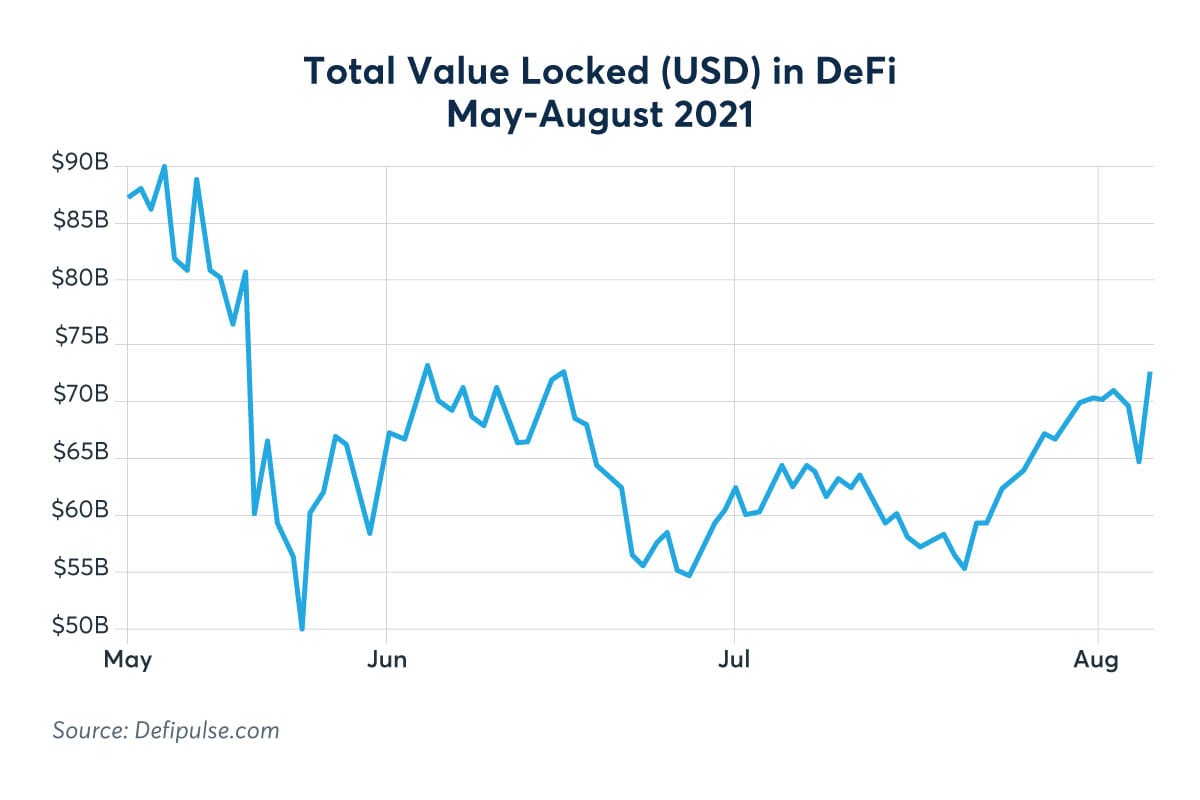
Together, with the accessibility of DeFi and the draw of better interest rates, more and more retail consumers will likely turn to the DeFi space. Even now, there are more than $65 billion worth of assets locked up in DeFi.
2) A New Type of Connectivity
We can think of Ethereum as an infrastructure, one with the potential to revolutionize both finance and technology.
DeFi is potentially recreating the entire financial system. Ethereum-based applications are likely to impact markets, governance, public services, and perhaps even how identity is managed. In the future, we may use the Ethereum platform to change the way mortgage transfers, securities trading and many other fields work.
What’s more, this will happen on a network that can reach anyone, anywhere, who can connect to a public network.
As these ideas come to fruition, Ethereum is a bet on a whole new type of connectivity and innovation layer, another driver in the value of the network.
Ethereum already has an active developer community and user base. It is one of the most popular digital currency networks across all metrics for Github activity, including number of commits, total contributors, total project watchers, and total stars. All of this points to an expanding and diversifying Ethereum ecosystem. For a blockchain, that’s the best story you can tell: a growing network, and key for the value of ether.
3) Proof-of-Stake Model
Both bitcoin and Ethereum currently operate using the proof-of-work consensus. The verification and confirmation of transactions requires a network-wide consensus by miners, who are rewarded for processing transactions and executing smart contracts.
If Ethereum 2.0 succeeds, the blockchain will have significantly more transaction-processing capability. That scalability is needed if Ethereum is to play a meaningful role in the global financial system and to be more environmentally friendly than proof-of-work alternatives such as bitcoin.
4) Speed and Scalability
Ethereum is different from bitcoin, as measured by two key metrics. Ethereum block times currently stand at between 10 to 15 seconds, compared to bitcoin’s 10 minutes; as well, an ether transaction will show in about five minutes, while it takes bitcoin about 40 minutes to complete a transaction.
This is because bitcoin’s first priority is security. Its coding language and restricted commands make it more difficult to hack the blockchain but adds more time to complete a transaction.
5) Disinflationary Supply
6) Correlation to Bitcoin
Ether is no longer following bitcoin’s price fluctuations as closely as it once did, as it is starting to be driven by its own catalysts. Ether’s correlation with bitcoin was 0.95 in July 2020. A year later, it is at 0.71, according to data from Cryptowatch.
Ether Futures
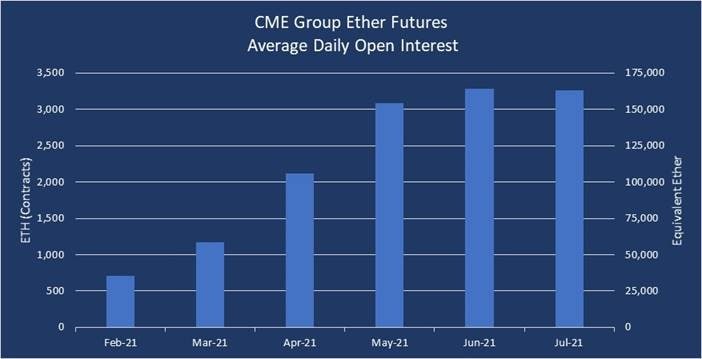
As a leading cryptocurrency futures exchange, CME Group added Ether futures to its suite of cryptocurrency products in February 2021.
Nearly 320,000 Ether futures contracts (~600k equivalent ether) have traded since launch. Strong institutional adoption and increased trading relative to Bitcoin futures has occurred as market participants use the contract to gain exposure to the token and hedge ether’s price risk.
It’s the kind of market activity worth watching as participants better understand all the use cases and applications of this breakthrough digital currency.
Image by Peter Patel from Pixabay
© 2026 Benzinga.com. Benzinga does not provide investment advice. All rights reserved.
To add Benzinga News as your preferred source on Google, click here.